There's a question I've been sitting with lately.
What if some of the most powerful minds reshaping our world were also, in some essential way, incomplete? Not lacking in intelligence. Not lacking in vision or drive. But missing something that, once you see it, is hard to unsee.
Iain McGilchrist — psychiatrist, philosopher, and author of The Master and His Emissary — has spent decades arguing that Western culture has become dangerously skewed towards one way of knowing. The left hemisphere of the brain: precise, analytical, goal-directed, brilliant at taking things apart and putting them back together in more efficient configurations. A remarkable servant, he says. But a poor master.
The right hemisphere, meanwhile — the one that sees wholes rather than parts, that understands context and relationship and meaning, that knows not just what something is but why it matters — has been progressively sidelined. Not just in individuals, but in our institutions, our education systems, our culture. And now, in AI.
McGilchrist has said something striking about artificial intelligence: that it is essentially the externalisation of left-hemisphere thinking. Procedural, Serial. And Explicit. It can process, optimise, generate. What it cannot do, what he argues, is strictly non-computable, is the work of the right hemisphere. The implicit knowing, the felt sense, the capacity for genuine relationship.
We have built, in other words, the most powerful left-brain tool in human history. And we are deploying it into a world already suffering from too much of the same. You can see this dynamic playing out in vivid, almost theatrical form in the tech world right now.
Without naming names, there is a recognisable archetype at the top of the AI revolution. Extraordinary analytical capability. Relentless drive. Systems thinking at a scale most of us can barely imagine. These are real gifts, and the achievements that flow from them are genuinely remarkable.
And yet.
Something is also being broken, repeatedly, in the wake of these achievements. Communities. Trust. Institutions. The careful, slow-grown fabric of how people live alongside each other. The deeply felt meaning and connections, that every human needs in their lives. Elon Musk is perhaps the most vivid current example — a man of almost superhuman technical vision, and yet one whose impact on the world seems to generate as much fracture as it does progress.
The question isn't whether he is intelligent. Clearly, he is, extraordinarily so.
The question is: what might that intelligence look like if it were also wise? If it were rooted not just in what can be optimised, but in what actually matters to people? If it were guided by something McGilchrist might call the right hemisphere, which is the part of the brain in touch with embodied feeling, with emotion, with the physicality of our existence and which is attuned to the heart.
Because the heart is not just a poetic idea.
Research from the HeartMath Institute — and a growing body of work in neuroscience and cardiology — has established something that would have seemed extraordinary even a generation ago: the heart has its own neural network. It communicates with the brain in ways we are only beginning to understand. And when the heart and brain are in a state of coherence — a measurable, physiological condition — our capacity for clear thinking, empathy, creativity and sound judgement is significantly enhanced.
This isn't soft. It's science.
The heart is not the seat of sentimentality. It is an organ of intelligence, one that processes information, responds to the environment, and plays a profound role in how we relate to ourselves and each other. In McGilchrist's terms, it might be the most embodied expression of right-hemisphere knowing that we have.
Which means that when we talk about the skills the future needs — relational awareness, contextual judgement, creativity, the capacity to hold complexity — we're not just talking about attitude or personality. We're talking about a form of intelligence that can be cultivated. That lives in the body. That grows through practice, through stillness, through genuine attention to ourselves and others.
I think about this in the context of the young people I work with.
They are growing up in a world being shaped at extraordinary speed by a particular kind of intelligence — one that is very good at solving certain kinds of problems and dangerously blind to others. They are also, many of them, turning to AI for emotional support, for company, for a sense of being heard. And AI, however sophisticated, cannot actually hear them. It can simulate the shape of a response. It cannot meet them in the way that another human being can.
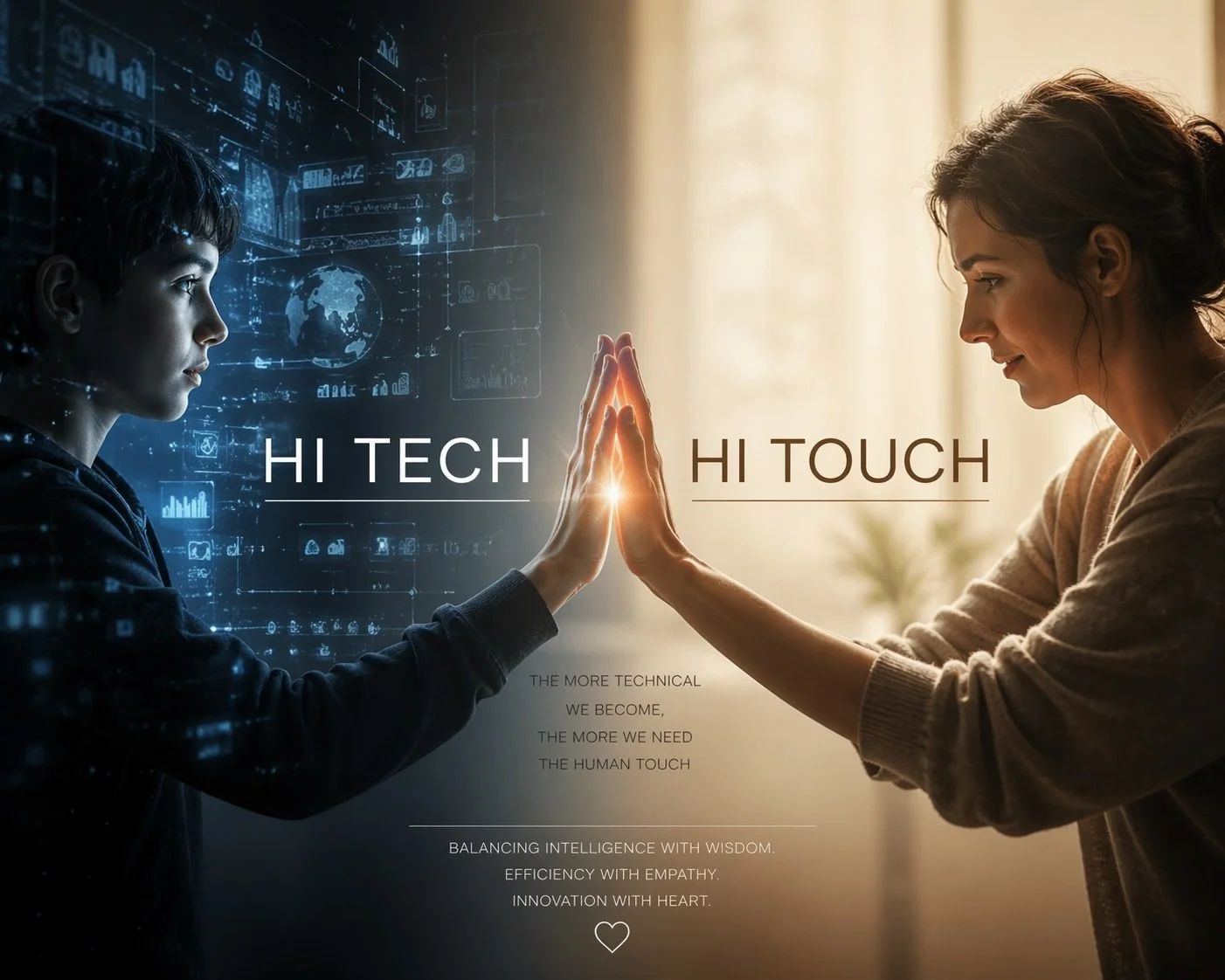
What they need, perhaps what we all need, is not to become more like the machines. It's to become more fully human. To develop the capacities that no algorithm can replicate: the ability to be genuinely present with another person, to sense what a situation calls for, to act from wisdom rather than just from data. Its what I call ‘Hi Tech-Hi Touch’. The more technical we become the more we need the human touch to balance it.
The HeartMath research suggests that heart coherence practices, simple, learnable, accessible to anyone — can significantly strengthen these capacities. That's not a small thing. In a world outsourcing more and more of its thinking to machines, the ability to return to yourself, to regulate your nervous system, to open your attention — these are becoming, quietly, among the most important skills a person can possess.
McGilchrist ends much of his work with a call for balance. Not the elimination of analytical thinking — we need that too — but the restoration of what he calls the true master: the wider, deeper, more embodied way of attending to the world that the right hemisphere, and perhaps the heart, makes possible.
Imagine what Elon Musk could do with that. Imagine what any of us could do.
The tools of the future are already being built.
The question is who is building them and what is driving them? Their left brain alone, or their right brain and their heart?
Interested in how we cultivate heart intelligence in young people? Take a look at Heart Works — a programme I co-created to help teenagers connect with the intelligence of their heart.